West Warwick, Rhode Island
Brake Caliper Replacement in West Warwick, RI
A seized caliper is the reason one wheel eats its pads while the other three look fine. The piston sticks, the pad drags, and that corner runs hot enough to glow. You feel it as a pull to one side every time you brake, and a burning smell when you park. Left alone, it warps the rotor, boils the fluid, and turns a caliper and a set of pads into a caliper, pads, a rotor, and a hose. We come to the car, find the stuck side, and replace the caliper where it sits — no tow, no shop, no guessing which wheel is the problem.
Get a Free Quote
Tell us what's going on with the car. We'll call you back with a price.
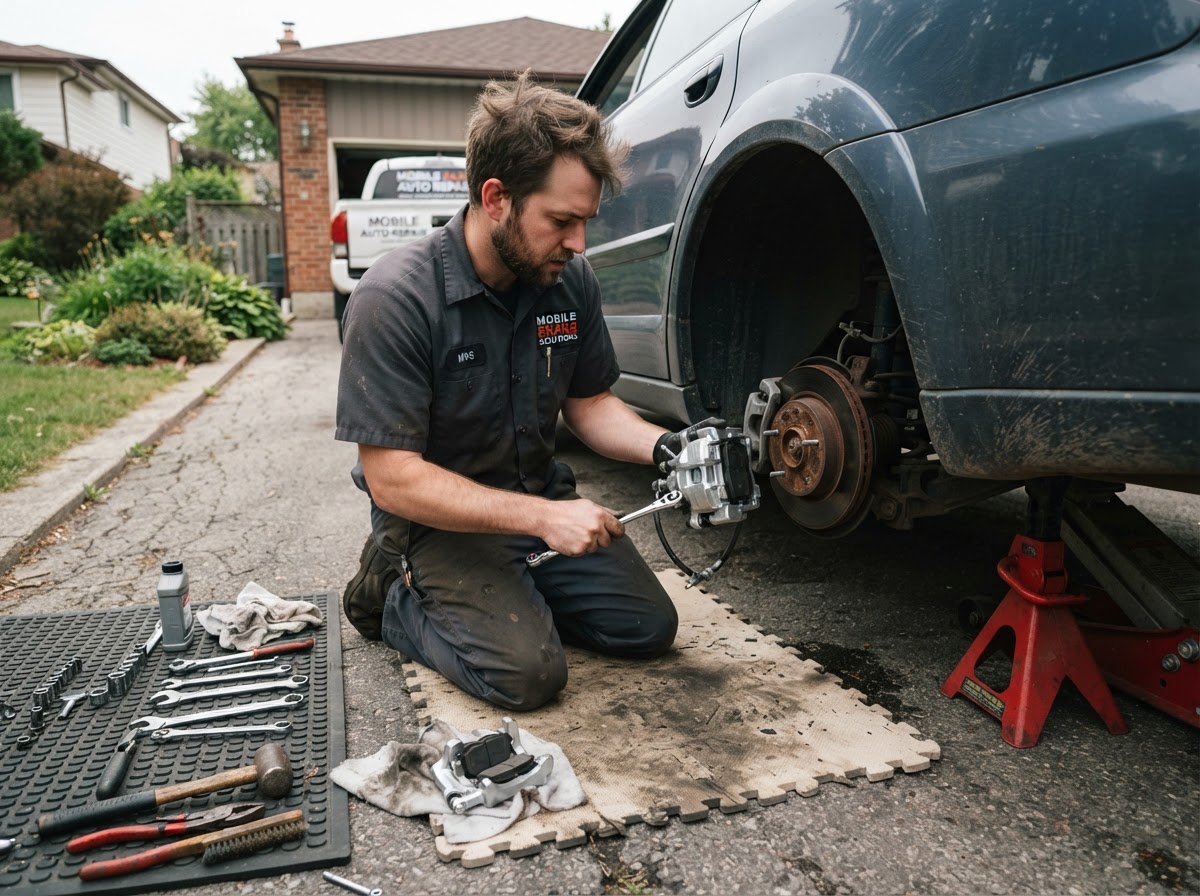
A seized caliper swapped in the driveway — new unit in hand, hub exposed, system bled and road-tested before we leave.
Signs you need this
When one wheel is doing all the work
A caliper doesn't usually fail all at once. It sticks, it drags, and it cooks everything around it. These are the signs the problem is on one corner — and which corner is usually obvious once you know what to look for.
- The car pulls to one side when you brake — the seized caliper is dragging on that corner, yanking the nose toward it every time you press the pedal.
- One wheel is far hotter than the others after a normal drive — touch the hub carefully, and the side with the stuck caliper will burn your hand while the rest are warm.
- Pads worn unevenly side to side on the same axle — the inboard pad on the stuck side is ground to nothing while the opposite side still has meat on it.
- The pedal stays down or drags after you lift off it, the caliper piston not retracting the way it should and leaving the brake partly applied.
- Fluid seeping near a wheel, a slow leak from a torn caliper seal or a rusted bleeder that's weeping onto the inside of the rim.
- A burning smell after driving, the stuck pad cooking against a rotor that's glowing hot enough to smell long before you see smoke.
What's included
What a caliper job actually covers
Replacing a caliper isn't just bolting on a new one. Here's the full job, from figuring out why it stuck to confirming it stops straight on the road test.
- Inspecting the caliper, the slides, and the flex hose to figure out whether the piston is seized, the slide pins are frozen, or the hose is collapsed — because the fix is different for each.
- Replacing the caliper with a new or remanufactured unit matched to your car, bolting it in and torquing the bracket to spec.
- Replacing the pads on that axle where needed, since a caliper that ate one pad usually ruined the others on the same corner.
- Bleeding the brake system at that corner and the rest of the axle, pushing the air out so the pedal comes back firm and high.
- Checking the rotor on that side for heat damage and scoring, and telling you straight if it needs to go too.
- A road test before we leave, confirming the car stops straight, the pedal holds, and nothing pulls or drags.
How long it takes
A realistic range
A single caliper replacement runs about an hour and a half to two hours once we're set up at the car. That covers pulling the wheel, diagnosing why it stuck, swapping the caliper, doing the pads on that axle if they're needed, and the full bleed. If the rotor on that side is heat-damaged and has to come off too, add a little time. We'll give you a real estimate on the phone based on the car and which corner is the problem, so you're not standing in the driveway wondering when we'll be done.
What it costs
What drives the price
We don't publish a dollar figure here, because the honest answer is that the price depends on a few things we can't know until we hear about your car. First, the vehicle — a caliper for a compact sedan isn't the same part or price as one for a heavy truck. Second, whether we use a new or a quality remanufactured caliper, and you choose that. Third, whether the pads and the rotor on that axle are ruined too, which we check before we quote. What we can promise is a real number before any work starts, not after. The fastest way to that number is a phone call with the year, make, and model and which wheel is the problem.
Driveway-ready
Can this be done in a driveway?
Yes — including the bleed. A caliper replacement doesn't need a lift or a shop. We bring a floor jack, stands, the caliper, the fluid, and a bleeder setup, and we do the whole job on a flat patch of driveway, a parking lot, or the street. Bleeding the brakes on the ground is the same process as on a lift — we push the air out one corner at a time until the pedal is firm. The only thing we can't do on site is machine a heat-damaged rotor back to true, but we carry new rotors for exactly that. You get the same job a shop would do, done where the car already sits.
Related brake work
Where to go next
If your brake problem sounds different, here's the parent category and a couple of other brake jobs we handle on site.
One hot wheel is a stuck caliper. Let's fix it before it gets worse.
Call now and we'll come out, find the dragging corner, and give you a firm price before we turn a bolt.