West Warwick, Rhode Island
Auto Electrical and Wiring Diagnosis in West Warwick, RI
You're dealing with an electrical fault — the kind of problem most shops dread and the kind most owners get quoted blind on. A dead window, a fuse that keeps blowing, a light that flickers for no reason — any of it could be a five-dollar fix or a five-hour hunt, and nobody wants to guess which. The right move isn't to swap parts until the symptom quits. It's to trace the fault to the break in the circuit and fix that. We bring the meters, the test lights, and the patience to your driveway and find it properly the first time.
Get a Free Quote
Tell us what's going on with the car. We'll call you back with a price.
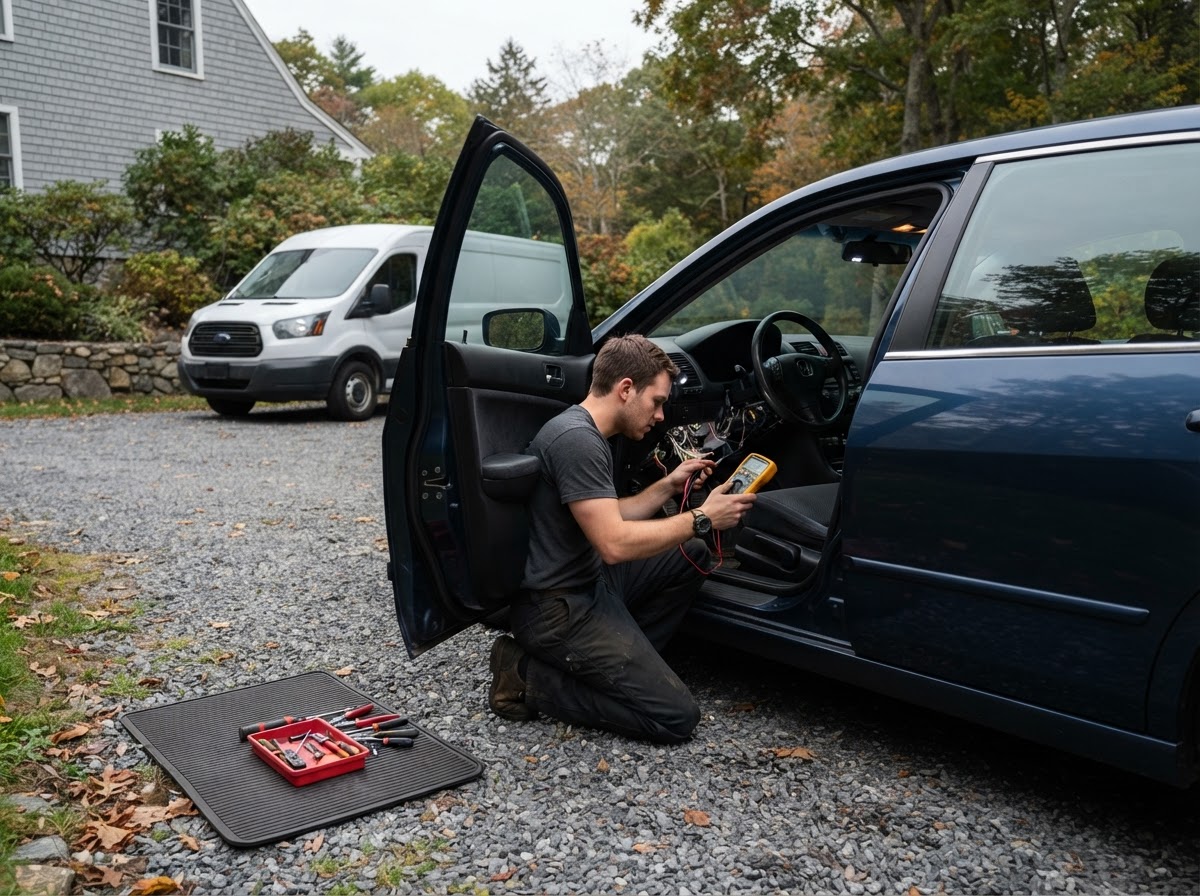
We trace the circuit in your driveway — meter in hand, no shop visit, no guessing which wire gave up.
Signs you need this
When the wiring goes quiet
Electrical faults don't always set a warning light — half the time the car just stops doing something it used to do. If any of these sounds familiar, it's worth a call.
- Accessories that quit working — power seats, wipers, the radio, a lighter socket — all at once and with no warning.
- Fuses that keep blowing. You swap one in, it pops the second you turn the key, and now you're chasing a short instead of driving.
- Dim or flickering lights, headlights or dash lamps that pulse with the engine rpm or fade the instant you hit the brakes.
- Power windows or locks that stopped — one door, all four, or the whole system gone dead at the same time.
- A battery that drains overnight. The car sits fine, you come out in the morning, and it's flat dead with no obvious cause.
- An aftermarket stereo, alarm, remote start, or trailer wiring that went in right before the trouble started — a frequent culprit and a smart place to start looking.
What's included
How we trace it down
There's no guessing in good electrical work — only measuring. Here's what we do once we're at the car, in plain terms.
- Voltage drop testing across connections, switches, and grounds to find where the circuit is losing power — a wire can look perfectly fine and still drop voltage the moment it's loaded.
- Circuit tracing from the load back to the fuse and the switch, following the path inch by inch until we find exactly where it breaks.
- Parasitic draw testing with the car asleep, measuring how much the systems pull when everything should be off, and isolating which one is staying awake and killing the battery.
- Ground and connector inspection for corrosion, loose pins, heat damage, and the green crust that builds up where wires meet metal and quietly starve a circuit.
- A plain explanation of what was found, what it'll take to fix it, and what it costs — before any wire gets cut or any part gets ordered.
How long it takes
An honest, wide range
Electrical faults vary more than any other job we do, and we'd rather tell you that straight than hand you a fixed number. A blown fuse or a bad ground can be pinned down in 20 to 30 minutes. A parasitic draw — something draining the battery overnight — can take an hour or more, because we have to let the car sleep, watch the meter, and pull fuses one at a time until the draw drops. A fault buried deep in a harness behind the dash can take longer still. We'll give you a real estimate once we see the car and hear what it's doing, and we won't run the clock without telling you where it stands.
What it costs
What drives the price
We don't publish a dollar figure here, because the honest answer is that the price depends on how long the hunt takes — and we won't know that until we're looking at the car. The cost comes down to the trip to come out, the time it takes to trace the fault to its source, and whatever parts or wire the fix actually needs. What we can promise is a real number before any repair work starts, not after. The fastest way to a quote is to call with the year, make, and model and tell us exactly what the car is — and isn't — doing.
Driveway-ready
Can this be done in a driveway?
Yes — for most electrical faults, the driveway is exactly where this work belongs. Everything we need to trace a circuit, measure a draw, and test a ground fits in the service vehicle and runs off the car's own battery. The exceptions are jobs that need a lift to reach wiring routed up inside the chassis or deep behind the dash, or faults that only show up on a road test at speed. If yours is one of those, we'll tell you straight and explain why, rather than charge you to find out in your driveway. Most window, light, lock, and fuse faults we handle right where the car sits, and the car's back to normal before we leave.
Related diagnostics
Where to go next
If your car's problem sounds different, here's the parent category and a few other diagnostics we handle.
Don't swap parts until it stops. Trace the fault.
Call now and we'll bring the meters to your driveway, find the break in the circuit, and tell you what's actually wrong — before you pay for a part that wasn't the problem.