West Warwick, Rhode Island
Radiator, Thermostat and Water Pump Replacement in West Warwick, RI
Three parts cause most cooling failures: the radiator that sheds the heat, the thermostat that opens and closes to regulate flow, and the water pump that moves the coolant through the whole loop. Each one fails in its own way and shows its own signs — a puddle under the car, a gauge that spikes, a heater that goes cold, a whine from the front of the engine. We test the system, figure out which of the three is at fault, bring the part, and swap it in your driveway so the temperature holds steady and the heat stops creeping up.
Get a Free Quote
Tell us what's going on with the car. We'll call you back with a price.
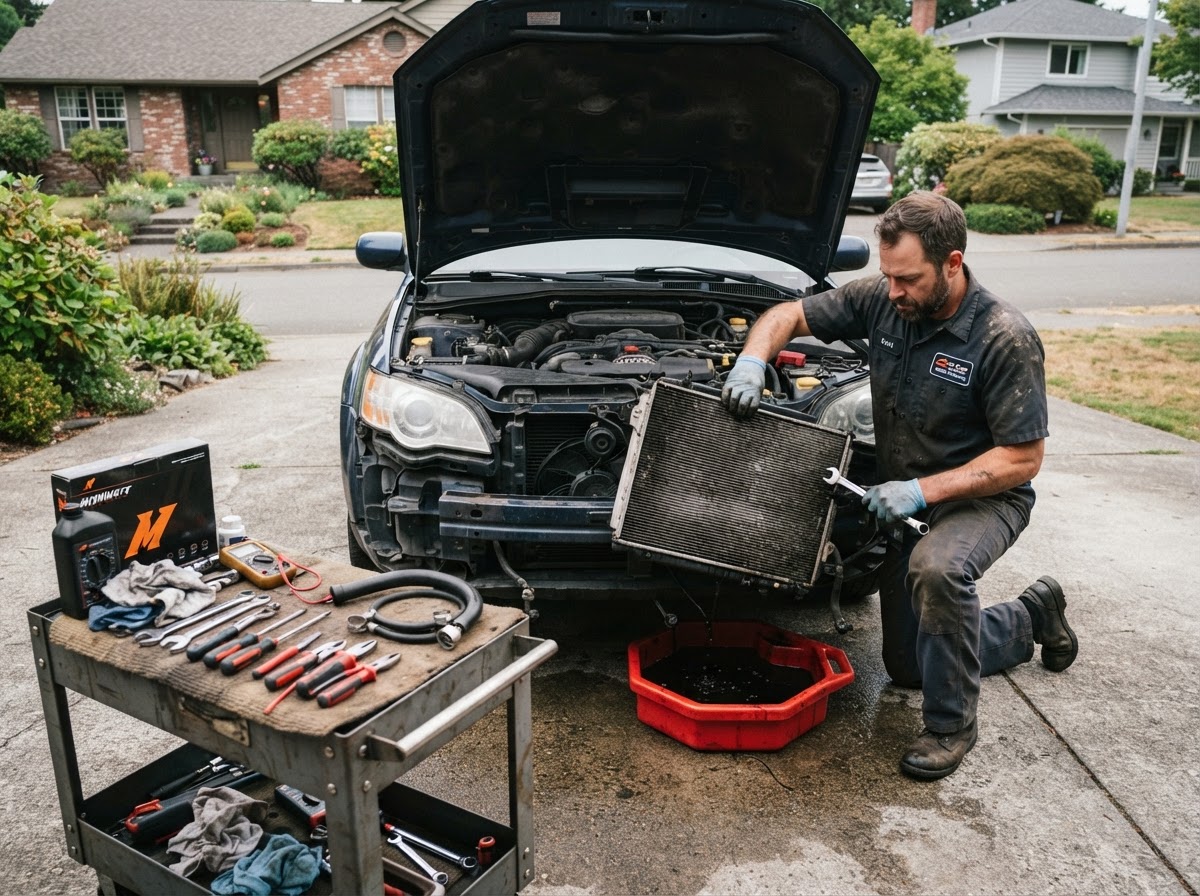
The old radiator comes out, the new one goes in — coolant drained, caught, and the system refilled and bled on the spot.
Signs you need this
When one of the three is failing
The radiator, thermostat, and water pump each leave their own fingerprints. These are the signs one of them is on its way out.
- A green or orange puddle under the car where you park, coolant weeping out of a seam, a hose end, or the water pump weep hole and pooling on the ground overnight.
- A temperature gauge that spikes then drops, climbing toward red and suddenly falling back to normal as a sticking thermostat opens late and lets flow through.
- A heater that blows cold, because the coolant isn't circulating through the heater core — either the system is low, the thermostat is stuck closed, or the pump isn't moving fluid.
- A whine or weep from the front of the engine, the sound of a water pump bearing going bad and the telltale dampness at the weep hole that confirms it.
- An engine that never reaches operating temperature, running cold on the gauge and never warming up the cabin, because a thermostat stuck open lets coolant cycle through unregulated.
- Coolant loss with no visible leak, the level dropping over weeks with nothing on the ground — which often points at a slow internal leak or a head gasket starting to go.
What's included
The three parts, and what each job covers
Each of these parts does a different job and fails in a different way. Here's what each one is, how it fails, and what replacing it involves — followed by a proper refill and bleed so no air is trapped in the system.
Radiator
The radiator is the heat exchanger at the front of the car — coolant flows through its thin tubes and the air passing through the fins pulls the heat out of it.
It fails by leaking at a tank seam or a cracked plastic end, by clogging internally with scale and rust so flow chokes off, or by getting blocked externally with bugs and road debris so air can't pass through.
Replacing it means draining the coolant, disconnecting the hoses and transmission cooler lines, unbolting the old radiator, and fitting the new one with fresh hoses and clamps where they're past their best.
Thermostat
The thermostat is a temperature-sensitive valve that stays closed until the engine warms up, then opens to let coolant circulate through the radiator once the engine reaches operating temperature.
It fails by sticking closed, which chokes off flow and overheats the engine fast, or by sticking open, which leaves the engine running cold, killing fuel economy and cabin heat.
Replacing it means draining enough coolant to clear the housing, unbolting the thermostat housing, swapping in the new thermostat with a fresh gasket, refilling, and bleeding the air out so the system circulates properly.
Water pump
The water pump is the heart of the cooling system — it's what pushes coolant through the engine, the radiator, and the heater core so the heat the engine makes actually gets carried away.
It fails by leaking at the weep hole, by wearing out the bearing and whining or growling from the front of the engine, or by shedding an impeller so it spins but doesn't move any fluid.
Replacing it means draining the coolant, removing the belt and anything in the way, unbolting the old pump, cleaning the mating surface, fitting the new pump with a fresh gasket, refilling, and bleeding the system.
Refill and bleed: After any of these jobs, we refill the system with the correct coolant, run the engine with the heater on, and bleed the air out at the bleed valve or the highest point — because a system full of air pockets will overheat even with brand-new parts. We verify the gauge holds steady and the heater blows hot before we pack up.
How long it takes
A range for each of the three
A thermostat is the quickest — about an hour to an hour and a half, including the drain, the swap, the refill, and the bleed. A radiator runs two to three hours depending on how much has to come off to reach it and whether transmission cooler lines are involved. A water pump is similar, two to three hours on most engines, and longer on the ones where the pump sits behind the timing cover. We'll give you a real range for your specific car on the phone.
What it costs
What drives the price
We don't publish a dollar figure here. The price depends on which part failed, the part quality you choose, and how much labor is involved — a thermostat up top is a different job than a water pump buried behind covers. It also depends on the coolant type and capacity your engine calls for. What we always promise is a real number before any work starts, and we confirm which part is actually at fault before we quote it. The fastest way to that number is a phone call.
Driveway-ready
Can this be done in a driveway?
Yes for most vehicles. A radiator, a thermostat, and a serpentine-belt-driven water pump all come out on flat ground with the tools we carry, and we refill and bleed the system on the spot. The honest exception is a water pump driven by the timing belt — on those engines the pump sits behind the timing cover, and getting at it means timing-belt work that's better done in a shop with the right setup and the right way to verify timing. We'll tell you straight which one yours is once we hear the year, make, and model, and we won't take the job if we can't do it right.
Related cooling work
Where to go next
Here's the parent category and a couple of related jobs we handle on site across West Warwick and the surrounding towns.
Cooling parts, straight
Questions about radiator, thermostat and water pump work
Cooling problem? Let's fix it where it sits.
Call 401-586-1696 and we'll come out, find which part failed, and give you a real price before we turn a wrench.