West Warwick, Rhode Island
Car Overheating Repair in West Warwick, RI
Overheating is one of the few problems where driving to a shop turns a moderate repair into an engine replacement. A stuck thermostat, a leaking hose, a dead fan — any of those is a few-hundred-dollar fix if you catch it in the driveway. Drive it another five miles with the gauge pegged and you're shopping for a head gasket or a whole engine. That's the whole reason we come to the car. We pressure-test the system, find what's actually failing, and fix it where it sits before the heat does the real damage.
Get a Free Quote
Tell us what's going on with the car. We'll call you back with a price.
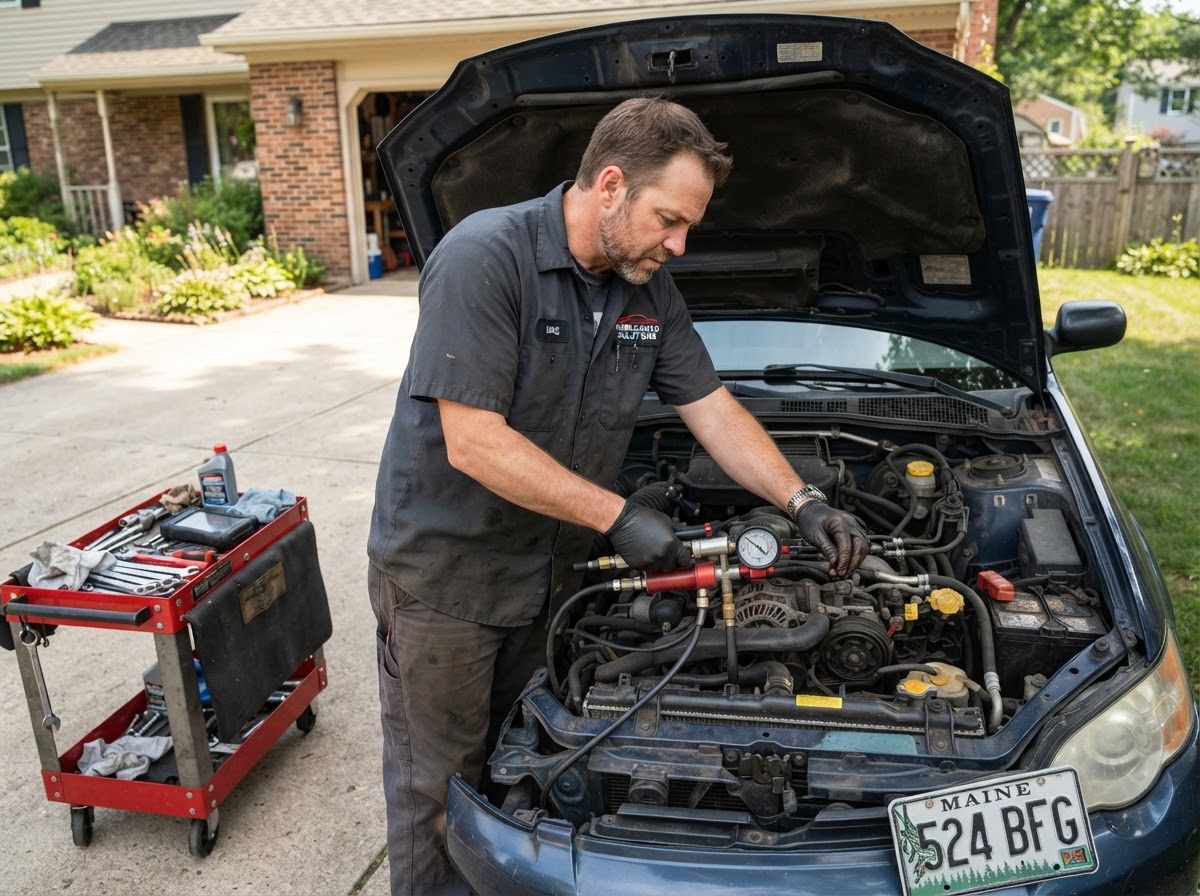
A pressure test finds the leak a visual check misses — before the gauge climbs any higher.
Signs you need this
When the engine is running hot
The cooling system warns you before it fails completely. These are the signs the car is already overheating or about to — and any one of them is a reason to shut it off and call.
- The temperature gauge is climbing above its normal resting spot, creeping past the halfway mark and heading toward the red zone where it never used to live.
- Steam from under the hood, that white plume rolling up when you stop at a light, telling you coolant is boiling over and the system can't hold the heat anymore.
- The heater is blowing cold even with the dial turned all the way up, which means there's no coolant reaching the heater core and the system is either empty or air-locked.
- Coolant needing topping up repeatedly, the overflow tank running dry every few days because the fluid is going somewhere it shouldn't and not staying in the loop.
- A sweet smell, that syrupy odor of hot antifreeze, drifting in through the vents or hanging around the front of the car after you park.
- Cooling fans that never come on, the electric fans at the radiator sitting silent even when the gauge is climbing, which usually points at a fan relay, a sensor, or a wiring fault.
Stop driving
Shut it off, don't drive it
If the gauge is climbing, steam is coming off the hood, or the warning light is on, pull over and turn the engine off. Do not keep driving to "see if it makes it." Every minute an overheating engine runs pushes you closer to a blown head gasket or a cracked head — and that's a repair that costs more than the car is worth on some vehicles. Let it cool, call us, and we'll come to where you're stopped. A tow is cheaper than an engine. A mobile repair is cheaper than both.
What's included
Find the cause before quoting parts
Overheating has a dozen possible causes, and the only way to know which one is yours is to test. Here's what a proper overheating diagnosis covers, from the pressure test to the fan check.
- Pressure testing the system to find leaks a visual check would miss — we pump it up and watch the gauge, because a slow seep at a hose end or a hairline crack in a tank won't show itself any other way.
- Locating leaks at the radiator, the hoses, the water pump weep hole, the heater core, and the thermostat housing before any part gets ordered.
- Checking the thermostat to see if it's stuck closed and choking off flow, or stuck open and letting the engine run cold.
- Checking the water pump for circulation and bearing play, because a pump that's stopped moving coolant is the same as no coolant at all.
- Checking the fans, the fan relay, and the coolant temperature sensor, because a cooling system that's full and leak-free can still overheat if the fans never kick on.
- Inspecting the radiator for external blockage and internal restriction, since a radiator clogged with bugs on the outside or scale on the inside can't shed heat.
- Identifying the actual cause before quoting any parts, so you're not paying for a radiator when the real problem was a forty-dollar thermostat.
How long it takes
A realistic range
Diagnosis alone — the pressure test, the fan and sensor checks, the thermostat and water pump inspection — usually runs 45 to 90 minutes once we're at the car. If the cause is a hose, a thermostat, or a fan relay, the repair can often be finished the same visit and you're back on the road that day. A water pump or a radiator replacement adds a couple of hours on top of the diagnosis. We'll give you a real time estimate on the phone when you call, based on what the car is doing.
What it costs
What drives the price
We don't publish a dollar figure here. The price depends on what's actually wrong — a thermostat is one cost, a water pump is another, a radiator is a third, and a head gasket is a different conversation entirely. It also depends on the vehicle, since some engines bury the water pump behind the timing cover and some have the thermostat in plain sight. What we always promise is a real number before any work starts, and we find the cause before we quote a part. The fastest way to that number is a phone call.
Driveway-ready
Can this be done in a driveway?
Yes for diagnosis and most repairs. A pressure test, a thermostat swap, a hose replacement, a fan relay, and most water pumps and radiators all happen on flat ground with the tools we carry. The one honest exception is head gasket work. A head gasket means pulling the cylinder head, machining the mating surfaces, and reassembling with new bolts and a precise torque sequence — that's shop work, not driveway work, and we'll tell you straight if that's what the test shows rather than take your money for a repair that won't hold. Everything short of that, we handle where the car sits.
Related cooling work
Where to go next
Here's the parent category and a couple of related jobs we handle on site across West Warwick and the surrounding towns.
Don't drive an overheating car. Call now.
Pull over, shut it off, and call 401-586-1696. We'll come out, find the cause, and fix it where it sits — before a small problem becomes an engine replacement.