West Warwick, Rhode Island
Tie Rod and Ball Joint Replacement in West Warwick, RI
The steering feels vague. The car wanders a little on the highway, the wheel responds a beat after you move it, and a clunk comes up through the floor every time you cross a seam. Most owners write it off as old-car feel and keep driving. What they're actually feeling is play in the tie rods or the ball joints — the joints that locate the front wheels and connect the steering to the road. These are among the few failures that can take the steering out entirely, because a ball joint that fails at speed lets the wheel fold. We inspect the front end, find which joints are worn, and replace them in your driveway before the vague feel becomes a dangerous one.
Get a Free Quote
Tell us what's going on with the car. We'll call you back with a price.
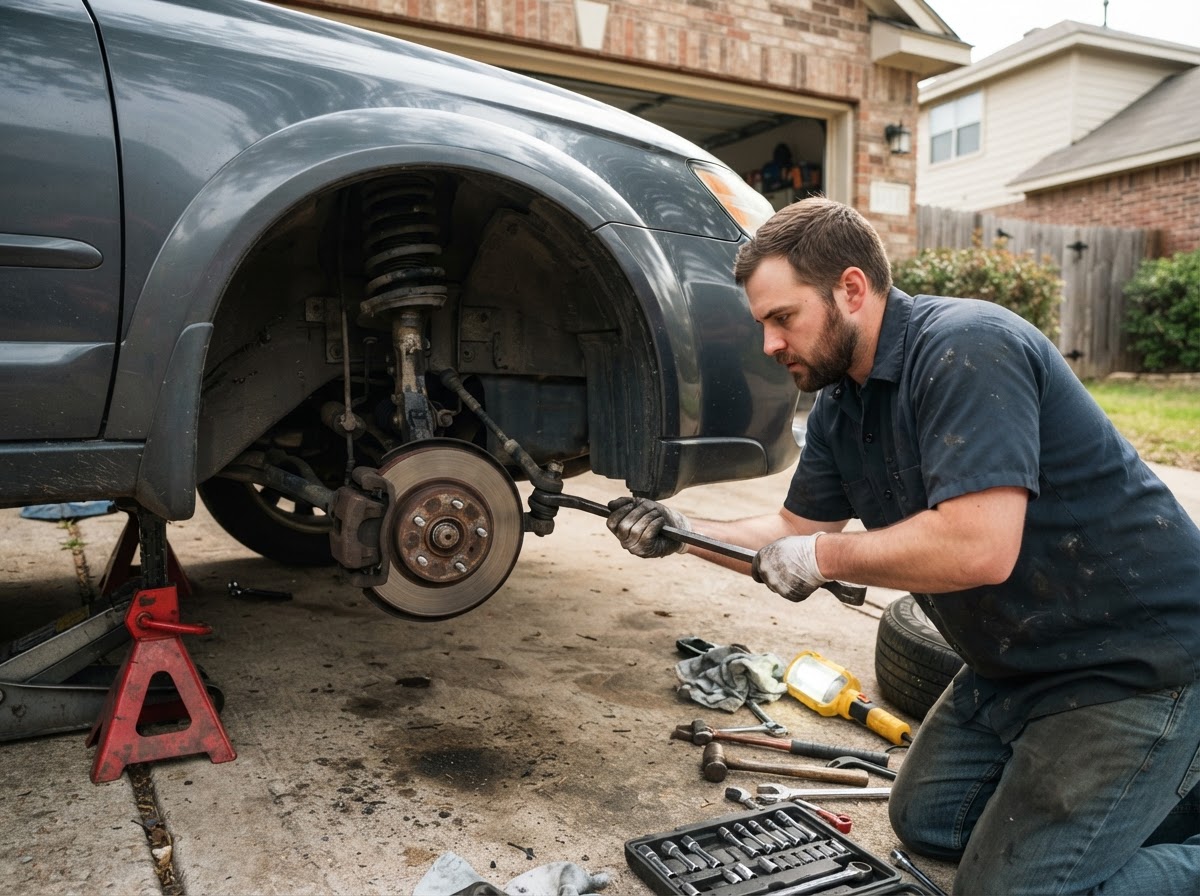
Inspecting for play, replacing what's worn, setting a rough toe so it's safe to drive to the alignment.
Signs you need this
When the steering has gone loose
Worn tie rods and ball joints show themselves in the handling and the tires. These are the signs the front end has play it shouldn't.
- Loose or vague steering, the wheel responding a beat after you turn it, the car needing constant correction to track straight on the highway.
- Wandering on the highway, the car drifting left or right even on a flat road, because worn tie rods let the front wheels toe in and out on their own.
- A clunk over bumps, a sharp rap from the front end when you hit a seam or a pothole, the sound of a ball joint or a tie rod with too much play slamming against its mount.
- Uneven or feathered tire wear, the tread worn smooth on one edge and ridged on the other, because a toe angle that's off shreds rubber across the tire.
- A vibration in the steering wheel, a shudder at speed that comes from a front end with enough play to shake through the column.
- A failed state inspection citing front end play, the rejection sheet that names tie rods or ball joints as the reason the car didn't pass.
What's included
Inspect, replace what's worn, set a rough toe
We don't replace parts blindly — we inspect, find the worn joints, and change only those. Here's the full job.
- Inspecting the inner and outer tie rods on both sides, checking for play at the socket joints and tears in the boots that let dirt and water in.
- Inspecting the upper and lower ball joints, prying under load to feel for play and looking for torn grease boots that have let the joint run dry.
- Checking for play at the wheels with the car on jack stands, feeling for the kind of looseness that tells you a joint has gone bad.
- Replacing the worn components — tie rod ends, inner tie rods, or ball joints as the inspection dictates — and reusing what's still good.
- Setting a rough toe so the car is safe to drive to the alignment shop, because the steering won't be aligned the moment we separate a tie rod.
- Telling you straight which joints are worn and which aren't, so you're not paying for parts that still have life in them.
Alignment
A proper alignment is required afterward
Separating a tie rod from the knuckle changes the toe, and there's no way to set it precisely in the driveway. We set a rough toe so the car is safe to drive, but the real four-wheel alignment is done at a shop with the laser equipment. Driving on a misaligned front end cups the tires and wears the new joints out early, so the alignment isn't optional — it's the second half of the job. We'll tell you straight and point you to a shop that does them.
How long it takes
A realistic range
Outer tie rod ends on both sides, where the inners are still good, run about an hour and a half to two hours — the inspection, separating the old ends, threading the new ones on at a rough toe, and the road test. Inner tie rods add time because the rack boots and clamps have to come off. Ball joints vary the most — some press out in minutes, others require a press and persuasion. We'll give you a real range on the phone once we know what the front end needs.
What it costs
What drives the price
We don't publish a dollar figure here. The price depends on what we find when we inspect — whether it's outer tie rods, inner tie rods, ball joints, or a combination, and how many corners are involved. It also depends on the vehicle, because some ball joints are bolt-in and some are pressed. We only replace what's worn, which keeps the cost honest. What we always promise is a real number before any work starts. The fastest way to that number is a phone call with the year, make, and model.
Driveway-ready
Can this be done in a driveway?
Yes. Tie rod ends and most ball joints come out with the car on jack stands and the tools we carry. We separate the joint, remove the worn part, thread or press the new one in, and set a rough toe so the car is safe to drive to the alignment shop. The only piece we don't do in the driveway is the precise alignment — that's the shop's job, and we'll be straight with you about that. Everything up to that point happens where the car sits.
Related steering work
Where to go next
Here's the parent category, a couple of related jobs, and a page for when a failed inspection is what brought you here.
Steering gone loose? Let's find the play.
Call 401-586-1696 and we'll inspect the front end, replace the worn joints, and set a rough toe so it's safe to the alignment shop.