West Warwick, Rhode Island
Wheel Bearing and Hub Replacement in West Warwick, RI
A wheel bearing starts as a faint hum you turn the radio up to cover. Then it's a hum at every speed. Then it's a growl that rises with the road and changes when you turn the wheel, and you're driving with the windows up wondering if it's the tires. Left long enough, a worn bearing runs hot, loosens up, and seizes — and a seized bearing locks the wheel at speed. It's a repair that gets louder and more dangerous the longer you wait, and it's a job we handle in the driveway with the right hub, the right torque, and the ABS sorted before we leave.
Get a Free Quote
Tell us what's going on with the car. We'll call you back with a price.
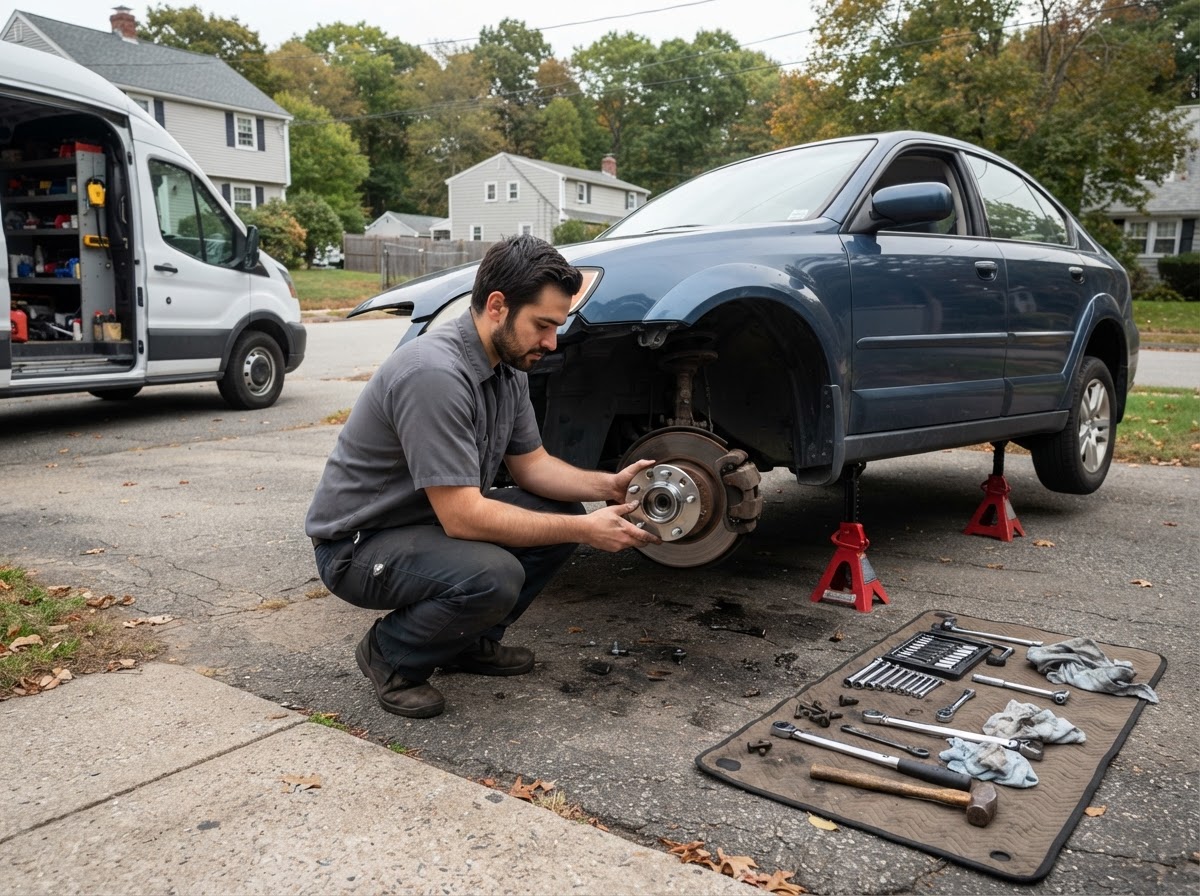
Road test to confirm the corner, then the hub, the sensor, and the axle nut torqued to spec.
Signs you need this
When the bearing is going bad
A bad wheel bearing has a clear set of symptoms, and most of them get louder the faster you drive. These are the signs it's time to have it looked at.
- A humming or growling that rises with road speed, the sound that's barely there at thirty and obvious by fifty-five, getting louder the faster you go.
- Noise that changes when you turn one way — louder when you steer left, quieter when you steer right, or the reverse — because loading the bad bearing changes how it growls.
- Play when the wheel is rocked, the tire and rim shifting when you grab the top and bottom of the wheel and push and pull, telling you the bearing has loosened.
- An ABS light on the dash, because a wheel bearing with a built-in ABS tone ring or speed sensor can trigger the light when the bearing wears or the sensor loses its signal.
- A vibration that increases with speed, the wheel or the seat shaking harder the faster you drive, because a rough bearing sends its vibration up through the hub.
What's included
Find the right corner, fix it right
A wheel bearing job is only as good as the diagnosis. Here's the full job, from the road test that confirms the corner to the torque spec on the axle nut.
- Road testing first to confirm which corner is actually making the noise, because a hum at the front can come from the rear and a bad tire can sound exactly like a bad bearing.
- Checking for play at each wheel with the car on jack stands, rocking the tire top and bottom and side to side to feel which hub has gone loose.
- Replacing the hub or bearing assembly with the correct unit for that axle, bolted in and torqued to the spec the hub requires.
- Transferring or replacing the ABS wheel speed sensor, because the sensor lives in the hub on most modern cars and a worn bearing can take the sensor tone ring with it.
- Torquing the axle nut to specification, because an under-torqued axle nut lets the bearing walk and die young and an over-torqued one crushes it.
- A road test after the repair to confirm the hum is gone and the ABS light stays off before we pack up.
Don't wait
This is not a repair to postpone
A worn bearing doesn't heal — it gets louder, it gets hotter, and it gets looser. Drive it long enough and the bearing can seize, locking the wheel while you're moving. That's the worst case, and it's not worth the risk to save a week. If you're hearing the growl and feeling the play, call us now. We'll come out, confirm which corner it is, and replace it where the car sits before a loud nuisance becomes a dangerous failure.
How long it takes
A realistic range
A bolt-on hub assembly on a car where it's easy to reach runs about an hour to an hour and a half per side — the road test to confirm the corner, the jacks, the disassembly, the new hub torqued to spec, and the road test to confirm the hum is gone. Pressed-in bearings that require a hydraulic press take longer and usually need a shop. We'll give you a real time estimate on the phone once we know what you're driving and which corner it is.
What it costs
What drives the price
We don't publish a dollar figure here. The price depends on which corner it is and whether your vehicle uses a bolt-on hub assembly or a pressed-in bearing. A bolt-on hub is a clean driveway job; a pressed bearing requires a hydraulic press and often a shop. The hub quality and whether the ABS sensor is part of the assembly also factor in. What we always promise is a real number before any work starts. The fastest way to that number is a phone call with the year, make, and model.
Driveway-ready
Can this be done in a driveway?
Yes, on most vehicles with bolt-on hub assemblies — which is most modern cars and a lot of trucks. The whole hub unbolts as a unit and the new one bolts in, with the axle nut torqued to spec and the ABS sensor sorted. The honest exception is a pressed-in bearing, where the bearing is pressed into the steering knuckle and the only way to remove and install it is with a hydraulic press. That's a shop job, and we'll tell you straight on the phone if yours is one of those rather than show up and discover it. For everything bolt-on, we do the whole job where the car sits.
Related suspension work
Where to go next
Here's the parent category, a couple of related jobs we handle on site, and a page for the ABS light a worn bearing can trigger.
Hearing that hum? Let's find the corner.
Call 401-586-1696 and we'll road test, find the bad bearing, and replace it where the car sits — before it seizes.